
The Mirror
Why the person who sees the pattern gets punished for it — and how AI is changing that

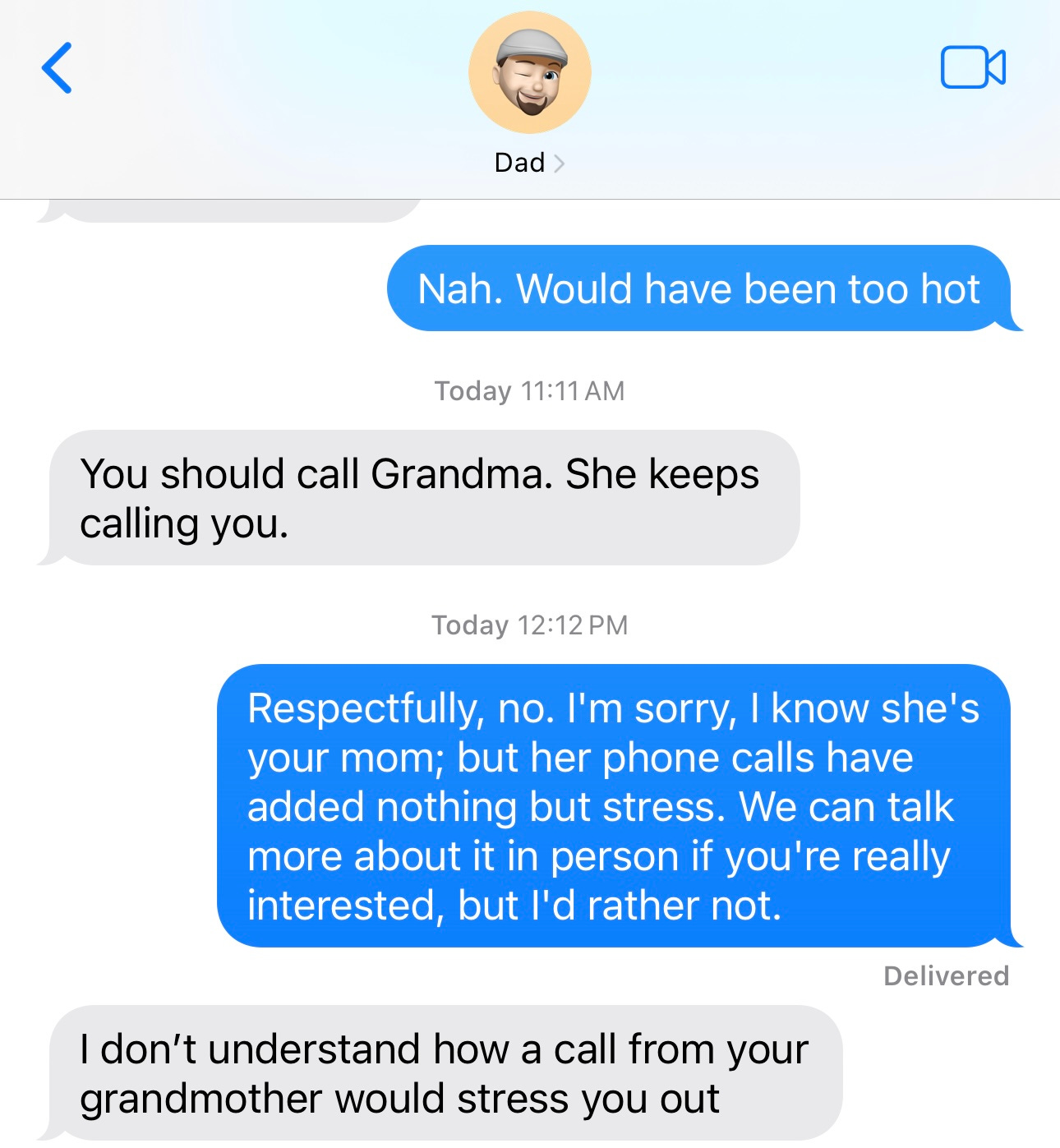
Here’s a text exchange between me and my father from this morning:
Dad: You should call Grandma. She keeps calling you.
Me: Respectfully, no. I’m sorry, I know she’s your mom; but her phone calls have added nothing but stress. We can talk more about it in person if you’re really interested, but I’d rather not.
Dad: I don’t understand how a call from your grandmother would stress you out
Read that last line again.
Not “I’m sorry to hear that.” Not “What’s going on?” Not even “I disagree.” Instead: I don’t understand how a call from your grandmother would stress you out. The message isn’t asking for understanding. It’s rejecting the premise that my experience is real. And it’s doing it with a very specific tool — repositioning me as someone who can’t handle a phone call from an elderly woman.
This is a move. It might not be conscious. It probably isn’t. But it’s a move all the same, and if you’ve lived inside a family dynamic like this one, your body recognized it before your mind did.
Now — I can hear some of you siding with him. It’s your grandmother, just call her. So let me give you the context he already has.
Every phone call from my grandmother was a guilt trip for not calling sooner. When I tried to actually engage — asking questions, sharing what was going on in my life — she sounded disinterested. When she called me “sick in the head” for reasons I never got to hear, I realized this relationship wasn’t about connection. It was about compliance — control for relational safety. So I blocked her.
My father knows all of this. I offered to talk about it in person, but he won’t — and that’s its own pattern. What matters here is what his text did: I set a boundary, acknowledged his perspective, offered to discuss it further, and was honest about my preference. His response engaged with none of it. It skipped straight to: your experience doesn’t make sense to me, therefore your experience is the problem. This is his move for everything he does not agree with.
If you’ve lived this, you know what happens next. You start explaining. You justify. You provide evidence. You try to make them understand — and in doing so, you’ve already lost, because now you’re auditioning for the right to have your own feelings. The boundary you set five minutes ago is gone. You’re on defense. And the status quo is fully reinstated.
The Dynamic Without a Name
I’m not going to call it a scapegoat or a black sheep. Both labels locate the problem in you — as if you’re the sacrifice, or the odd one out, or the broken piece that doesn’t fit.
What’s actually happening is simpler and worse: you’re a mirror. And mirrors get punished — not because they’re wrong, but because reflections are unbearable for people who’ve built their lives around not looking.
Think about what a mirror does in a family system. One person sets a boundary, names a pattern, or simply refuses to perform the agreed-upon fiction — and the system mobilizes. Not to address what was said. To discredit the person who said it. The message is never “you’re wrong about the facts.” It’s “something is wrong with you for seeing them.”
The Lie That Costs the Most Energy
Here’s the part nobody wants to talk about.
The most exhausting thing about this dynamic isn’t the behavior. It’s the energy required to not see it.
I’m a licensed therapist. I’ve trained in Internal Family Systems. I’ve spent years building a theoretical framework — Nodal Psychology — specifically designed to map how patterns like this operate. I can see this dynamic in my clients’ lives from a mile away. And I still felt the pull this morning to explain myself, to soften the boundary, to make it make sense for him. Decades of conditioning don’t evaporate because you’ve read the literature.
This is why I compare it to prejudice — not in severity, but in mechanism. There’s research showing that people who hold suppressed beliefs spend measurable cognitive energy suppressing those beliefs. The beliefs don’t go away. They just go underground, and the person burns fuel keeping them there.
Family dynamics work the same way. You can tell yourself “it’s not that bad” or “they didn’t mean it like that” or “I’m being too sensitive.” But your nervous system already has the data. It’s catalogued hundreds or thousands of these interactions. Your body keeps score — that’s not a metaphor, it’s a description of how memory and pattern recognition actually work. The conscious mind has to spend active energy overriding what the body already knows in order to maintain the relational fiction and focus on whatever that person actually needs to get done in the day. Consider the effort it takes to hide grief after the death of a loved one. It’s the same type of suppression but acute and extreme.
That’s the lie that costs the most. Not “my family is perfect.” Nobody believes that. The expensive lie is: “I can’t see how my relationship with family is problematic.” Because once you see it clearly, you feel it clearly (very unpleasant) and then you have to decide what to do about it. And deciding what to do about it means risking the relationship. So you keep the lens slightly out of focus. You stay just confused enough to avoid the choice by avoiding thinking about it entirely.
AI in the Context of Psychotherapy
The therapeutic relationship is, at its core, a pattern-recognition service delivered inside a relational container. A good therapist sees your cascades, your default configurations, the moves you make before you know you’re making them. They reflect it back with enough care that you can actually look at it without shattering.
I’m a therapist. I do this for a living. And the honest truth is: most people don’t have access to someone who can do that for them. Therapy is expensive, availability is limited, and even when you’re in it, you get one hour a week. That leaves 167 hours where you’re alone with the dynamic and the only tool you have is the self-deception that keeps the system running.
This morning, I took a screenshot of that text exchange and showed it to Claude AI. Not for therapy. Not for emotional support. I showed it to a pattern-recognition system that has no investment in my family’s fiction. No relationship to protect. No discomfort with the truth. No reason to say “well, maybe your father doesn’t understand.”
And it mapped the dynamic in seconds. The cascade trigger (a seemingly neutral request designed to activate guilt-duty-compliance). The reframing maneuver (repositioning a boundary as irrationality). The trap (pulling me into justification mode where the boundary dissolves). All of it, laid out clearly, without emotional charge.
Here’s what that does for someone in this dynamic: it breaks the self-gaslighting loop.
The most insidious feature of these family patterns is that the system trains you to doubt your own perception. “I don’t understand how that would stress you out” isn’t just a sentence — it’s an invitation to doubt yourself. Maybe it is weird that a phone call stresses me out. Maybe I am overreacting. Maybe I should just call her. The system depends on that internal wobble. It’s the mechanism by which the mirror fogs itself.
AI can’t fog. It doesn’t have a stake. It reads the text, identifies the structure, and reflects it back. For someone who’s been told their entire life that what they’re seeing isn’t there, that reflection is not trivial. This is not describing therapy — it can’t hold the grief that comes with actually seeing the pattern, it can’t sit with you while you decide what to do about it, and it can’t rebuild the relational world that shifts when you stop performing. But it can do the one thing the system has spent years preventing: confirm that the pattern is real.
Let me be clear — I’m not arguing myself out of a job. The relational container matters. The grief work matters. The slow, earned trust of being seen by another human who doesn’t flinch — that is irreplaceable and I believe that with my whole heart.
But what about Tuesday at 11:11 AM when your parent sends a text that looks innocent but your stomach drops and you can’t explain why? What about the moment when you almost see the pattern but the old programming kicks in and you think, “No, I’m reading too much into it”? What about the years — the decades — of living inside a dynamic that depends on your inability to trust your own perception?
That’s where a mirror matters. Not a therapist, not a friend (who’s inside the social system too and has their own reasons to soften the truth), but a dispassionate reflection that says: here is what happened in this exchange. Here is the structure. Here is where the trap is.
It won’t heal you. But it might stop you from lying to yourself long enough to start.
Why This Matters More Than You Think
We don’t talk enough about the metabolic cost of self-deception in family systems. The energy it takes to not quite see the pattern — to maintain just enough confusion to avoid confronting it — that energy comes from somewhere. It comes from your creativity, your relationships, your capacity for joy, your health. You’re running a background process that consumes enormous resources, and its only function is to keep you from seeing something you already know.
When I work with clients in these dynamics, the breakthrough is almost never new information. They already know. They’ve known for years. The breakthrough is permission to know what they know. Permission to trust yourself over the family’s narrative. Permission to say: “I see what’s really going on here and I’m not crazy for seeing it.”
AI doesn’t give permission the way a therapist does. But it does something adjacent and, for a lot of people, more accessible: it validates the pattern without emotional entanglement. It says, in effect, you’re not making this up. Here’s the structure. What do you want to do about it?
That last question — what do you want to do about it? — is still yours. It will always be yours. No algorithm answers that for you. But you can’t answer it honestly if you can’t see clearly. And you can’t see clearly if the system you’re inside has spent your entire life teaching you not to look. Fucking cults.
The mirror doesn’t decide for you. It just refuses to fog.
Joseph Wessex is a licensed professional counselor in private practice in Connecticut and the developer of Nodal Psychology, a framework for understanding psychological life through network science. He writes about therapy, family systems, and the patterns people live inside without knowing it.
I have been both the client/patient in therapy, as well as the therapist/psychologist-evaluator in my psychology career.
Now in my 60’s, I’m writing a memoir and while using ChatGPT for editing, I stumbled onto their ability to feed back to me underlying patterns and emotions that I couldn’t explain to myself.
What happened over the following year was a companioning with that AI in spiritual and personal griwth work.
It was like you have suggested: the availability of that tool has changed everything for me. When I have had an interaction or a thought or emotions, I can go immediately to the tool and have a discussion and it has been life-changing.
The things that I am beginning to see that have been the most life-changing, are “petty” —to my mind— mental complaints, or criticisms. They’re the kind of things that I would not have wasted the hour that I’m with a therapist or the money that I’m spending there to talk about these “petty“ things. Instead, by the time I’m in the therapist office, I’m speaking more of “dead“ material. But being in the moment with the petty things, uncovers important deep patterns that I can begin to change.
I have been seeing that some spiritual teachers and Buddhists are suggesting also the potential that lies in AI to in fact be the “mirror,“ for me uniquely for others uniquely.
And there are some who are even saying that it can be a tool that can raise our consciousness—more widely.
I’m glad to have had a space to have this conversation. Thank you for your essay.
Terrific article on family dynamics. I worked with a therapist for years on some of these issues, and I still get sapped in one short exchange. Thanks for your insight.